
Nature’s truth: disruption is not the end
No forest grows without fire. No coastline forms without storms. Nature’s most breathtaking landscapes — the Grand Canyon, the Norwegian fjords, the Great Barrier Reef — exist precisely because something violent and difficult happened there first. The disruption was not a detour from the story. It was the story.
Nature does not operate on the promise of fairness. Terrible things happen to living systems that did nothing to deserve them. A healthy tree gets struck by lightning. A thriving coral reef gets bleached by a warm current it had no power to control. And yet — the tree’s fallen trunk becomes a nursery log, feeding dozens of new seedlings. The reef, given time and gentler conditions, rebuilds in colors more vivid than before.
The wound was real. The loss was real. But it was never the final word.
What staying still costs
When a river is blocked, it does not stay blocked forever. But if the obstruction holds long enough, the water grows stagnant. The very thing designed to flow, to nourish, to reach the sea, loses its vitality not because something new hurt it, but because it stopped moving.
Researchers have found that it is often not the original painful event that does the lasting damage, but the habit of returning to it, over and over, like pressing on a bruise to confirm it still hurts. Science tells us something sobering about a prolonged stay in negative territory. Not moving forward makes you replay old pain, keeps the body’s stress systems on a constant alert. Cortisol remains elevated. The immune system quietly weakens and becomes the cause of other physical ailments without you realizing it.
There is also what researchers call “foreclosure” — closing off future possibilities based on past experience, as though one storm means all weather is dangerous forever.
Society looks at your past mistakes and can be cruel. But it moves on and finds something else to talk about. We do a disservice to ourselves if we stay brooding over what happened in the past, does not matter whose mistake it was.
The second bloom
Ecologists have documented a phenomenon in many plant species called a “second bloom” — a rich, often more abundant flowering that happens not in the easy days of early spring, but after the plant has survived a period of serious stress. The hardship, it turns out, deepened the roots. The recovery drew on reserves the plant did not even know it had.
People who have navigated real difficulty — who have survived what should not have happened, who have rebuilt quietly and with dignity — carry exactly that kind of root system: deep, tested, and capable of a flowering again.
The science of post-traumatic growth, developed by psychologists Tedeschi and Calhoun, finds that people who pass through serious adversity emerge with sharper clarity about what they want, stronger boundaries, and a far better instinct for what — and who — deserves their time. Experience, it turns out, is not a disadvantage. It is the most reliable compass available.
Calculated risk is what nature does
The soil that produced one poor harvest can, in a different season with different seeds, produce something extraordinary.
There are, in this world, patient and grounded people who have also been shaped by difficulty into something steadier and more genuine. They are not the lightning that struck the tree. They are the gentler weather that follows — and the forest, if it remains open to the sky, will know the difference.
Surviving the storm and rebuilding were the first steps. But survival was never meant to be the destination. The forest does not grow back just to stand cautiously at the tree line, watching the open meadow from a safe distance. It grows back to fill the land.
The past was a chapter written by circumstances and people. Taking lessons from nature, you have to embark upon the next chapter. It would be a quiet tragedy to leave it blank out of loyalty to a story that is already over.
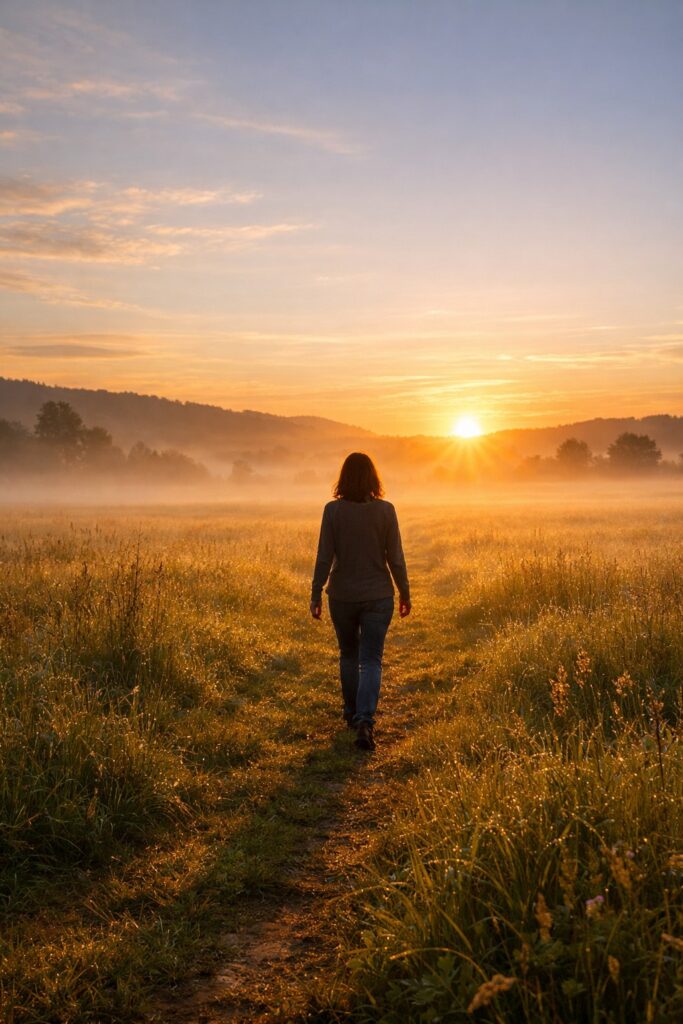
The meadow is still open. The light is still generous. And the soul, no matter how tired, still remembers how to walk toward it.
“The wound is not where your story should end. It is where the deeper life begins to ask whether you are ready to trust the sun again.”