
The sun leans down. The water yields, lets go of ocean, pond, and fields, and rises light, too fine to see — a thousand pieces, wandering free.
But height was never what it sought. The scattered come back to the thought, and gather close, and grow, and fall, and answer earth’s old downward call.
No one had to send for rain. It never waited to be prayed, nor asked what service it was paid — it came, and came, and came again.
Yet let it tarry one long season: the grain goes brown, the well goes dry, the cattle thin, the children cry. It needs no summons. We need reason.
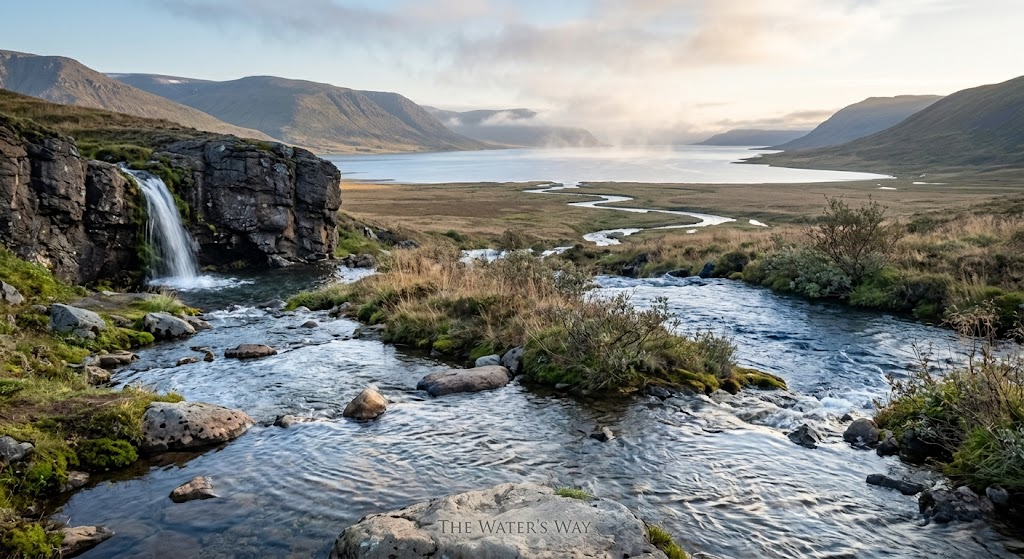
It joins again. It finds its kin. A thread, a brook, a river’s din, a white fall flung from cliff to stone — the parted never stay alone.
A rock in the way? It works around, soft, in no hurry, making no sound. But hem it in with mountain stone, and it will cut a way alone.
They take it for the cup, the mill. They foul it, and it carries still — their silt, their leavings, all their weight, downhill, unhurried, and not late.
It asks no name. It keeps no score. It does the duty it was for — assigned before the world’s first start — and does it with an even heart.
You may not know what you were sent to soften, carry, cool, or mend. No drop was ever told its end; it fell, and where it fell was meant.
So be like water, friend, and go where life is dry, and hands are bare. Do right without the need to know: the doing is the errand there.
A note on the poem
Water is the most ordinary thing in the world, and the most instructive. It has no ambition. It goes up only because the sun lifts it, and the moment it is up, it starts looking for a way back down. Height is not what it wants.
What struck me is that water never waits to be asked. No one sends for the rain. It arrives without being prayed for, without being thanked, without any accounting of who deserves it and who does not. And yet if it comes late, the grain browns and the well runs dry. It owes us nothing, and everything depends on it. That is a strange and humbling arrangement to sit with.
It is also stubborn in a way I admire. Put a stone in its path, and it goes around without complaint. Put a mountain in its path, and it does not go quiet — it takes a thousand years and cuts through. We call water soft. Softness that patience is not weakness.
And it does not mind being used. It turns the mill, fills the cup, washes what is dirty, and carries the silt and leavings downhill without arguing the matter. It stays useful even when it has been fouled. That seems to me a harder discipline than purity.
The part I keep returning to is that no drop knows its assignment. It does not know whether it will soften a field, cool a fever, or simply pass through on its way to somewhere else. It falls, and where it falls turns out to be the place it was needed. Perhaps that is enough instruction for a life: you may never learn what you were sent to do. Go where things are dry, do what is right in front of you, and let the doing be the answer.