Walk into any Gurdwara in the world today, and the experience is broadly the same. You remove your shoes, cover your head, and enter a hall where the Guru Granth Sahib rests under a canopy. Kirtan fills the room. Eventually you make your way to the Langar hall, sit on the floor alongside strangers, and share a meal that someone prepared and served without payment or expectation in return. It feels ancient, because it is.
The Gurus did not leave us a blueprint for buildings. They left us a blueprint for responding to human need. The forms were always meant to change. The principles were never meant to.
If Guru Nanak were founding a dharamsala today, it would almost certainly include food security, health care, education, youth mentoring and support, legal assistance, and mental health support — not because these are modern ideas imported from outside the tradition, but because they are today’s expressions of the same Sikh principles that produced the original institution. Understanding how and why the dharamsala was built the way it was makes that continuity impossible to ignore.
Built to Solve Problems, Not to Preserve Forms
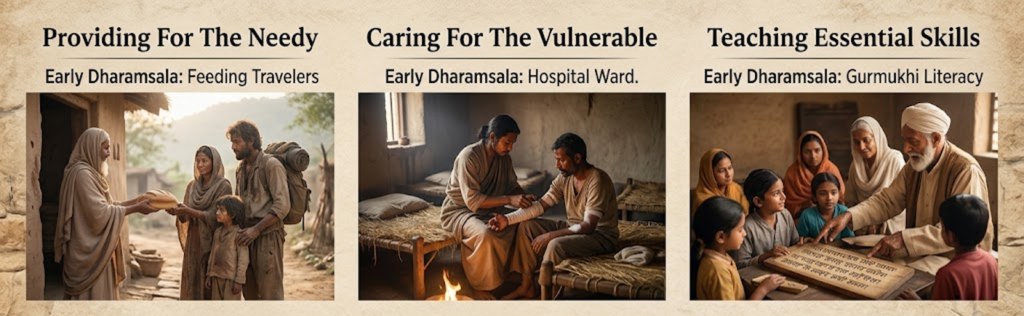
In the early 16th century, Guru Nanak did not set out to build a temple. What he created — first at Sultanpur Lodhi and then most fully at Kartarpur on the banks of the Ravi River — was called a dharamsala, meaning roughly “inn of the dharma.” The word itself is instructive. An inn is not a monument. It serves whoever arrives at its door.
The early dharamsala was built around a specific social problem: in 15th-16th-century Punjab, caste determined where you sat, who cooked your food, and who was permitted to eat beside you. Travelers on trade routes had no safe place to rest that didn’t enforce those hierarchies. The sick had no place to recover. The hungry had no recourse. The dharamsala was Guru Nanak’s answer to all of these simultaneously — not through charity dispensed from above, but through a societal and structural daily practice that dissolved those distinctions entirely.
The Langar — the free community kitchen — was not a supplement to the institution. It was the institution’s most direct statement. The Emperor and the laborer sat on the same floor and ate the same food. This was not symbolic. It was repeated, daily, inescapably practical.
Every subsequent Guru deepened the community function by identifying a new social problem and designing a response to it. Guru Angad formalized Gurmukhi script — because ordinary Punjabi people couldn’t access their own scripture in Sanskrit or Persian. Guru Amar Das required even the Mughal Emperor to sit on the Langar floor before an audience — because hierarchy was the problem, and no one was exempt from the solution. Guru Arjan built the Harmandir Sahib with entrances on all four sides — because the architecture itself needed to say that no direction of approach, and no category of person, was more welcome than another. Guru Hargobind placed the Akal Takht directly opposite — because the institution’s responsibility to the world, not only to the next life, needed its own permanent, visible structure.
In each case the question was the same: what problem does this society face, and how does this institution respond? The answer changed each generation. The question never did.
When Institutions Stop Evolving
Every institution faces a common temptation: preserving yesterday’s solutions instead of solving today’s problems. Buildings outlive founders. Procedures outlive purposes. Traditions that once solved urgent problems become rituals repeated without asking whether the underlying need has changed.
The Gurdwara has been through this before. During prolonged Mughal persecution in the 17th and 18th centuries, many Gurdwaras passed into the hands of caretakers called mahants, who managed them as hereditary personal properties. Over time, these institutions were reduced to purely ritual functions. The Sikh community fought for over a century to reclaim them, winning when the Sikh Gurdwara Act of 1925 returned control through the newly formed SGPC. The entire basis of that struggle was the argument that Gurdwaras were community institutions with a mandate broader than ritual. The community understood, even after generations of erosion, what the institution had originally been built to do.
The drift today is different in cause — it comes not from outside interference but from an overly cautious reading of what a sacred institution is permitted to do. But institutional drift looks the same from the outside regardless of its cause. A Gurdwara that limits itself to worship alone has preserved the form while quietly setting aside the purpose.
The Needs Change. The Principles Do Not.
The social problems Guru Nanak’s dharamsala was built to address have direct equivalents today. They are not the same problems — the specific vulnerabilities of 16th-century Punjab are not identical to those of a 21st-century diaspora community in North America or Europe. But they are the same kind of problems: people without food, without care, without access, without a door to knock on.
| Then | Today |
| Gurmukhi literacy for scripture access | After-school tutoring, ESL, digital literacy |
| Youth mentoring & guidance | |
| The sick with no place get treatment and to recover | Free Medical Clinic for uninsured and underinsured patients, mental health support |
| Langar for the hungry. Shelter for strangers on the road | Food insecurity, food pantries, transitional housing |
| Travelers with nowhere to sleep | Homeless families, newly arrived refugees, Battered women |
| Sangat as community belonging | Elder classes and technology support, Medicare/Medicaid guidance |
| Domestic violence resources, elder loneliness, youth disconnection |
This is not a theoretical exercise. It is already happening in many places. Khalsa Aid responds to natural disasters and refugee crises around the world, drawing directly on the Langar principle extended to its logical reach. Free medical camps and blood drives run out of Gurdwaras in cities across the diaspora. Community legal clinics, youth mentorship programs, and senior support services have taken root in Gurdwaras that chose to ask what their surrounding community actually needs. These are not departures from Sikh tradition. They are its continuation — the same adaptive response to the same underlying question, carried forward into a different century.
Recovering the Vision
To those who lead Gurdwaras today, the question worth sitting with is not “should we be a place of worship or a community center?” That framing accepts a false choice. Guru Nanak never separated these. In his framework, worship without service was incomplete. Service without the grounding of worship risked becoming ego-centric. The two were designed to check and complete each other, practiced together daily so that neither could drift too far from its purpose.
The more honest question is: what problem is this institution solving today, for the people who live within reach of it — Sikh and non-Sikh alike? If the answer is only “we preserve our religious practice,” that is worth something, but it is not the full answer the founders had in mind. The Nishan Sahib that flies above the Gurdwara is visible to the whole neighborhood. It was always meant to signal to that whole neighborhood: there is help here, there is food here, there is dignity here, regardless of who you are.
Imagine walking into a Gurdwara where someone can receive kirtan in the Darbar Sahib, lunch in the Langar hall, help navigating a citizenship application, tutoring after school, grief counseling after losing a spouse, guidance on choosing a career, and companionship in old age. A support group ensures that grieving families are not alone; they have guidance to take care of death in the family. None of these diminish the spiritual mission of the Gurdwara. They fulfill it. The Guru’s door has always opened toward both God and humanity — and it was never designed to open toward one while remaining closed to the other.
The Gurus did not leave us a blueprint for buildings. They left us a method: identify the need, respond with principle, adapt the form, hold the purpose constant. Five hundred years later, the method still works. The only question is whether those entrusted with these institutions are willing to use it.
A Message to Today’s Leaders
To those who lead Gurdwaras today and argue that their sole purpose is religious worship, the question worth sitting with is this: what exactly are you preserving? If the answer is the kirtan, the Ardas, the reading of Gurbani — those are worth protecting absolutely. But Guru Nanak did not build an institution whose walls contained only prayer. He built one whose walls contained prayer and a kitchen and a lodge and a place of healing, because he understood that a hungry person cannot fully engage in worship, that a sick person needs a hand before they need a hymn, and that a community institution which serves only its own members in only their spiritual needs has already abandoned half of what it was sent into the world to do.
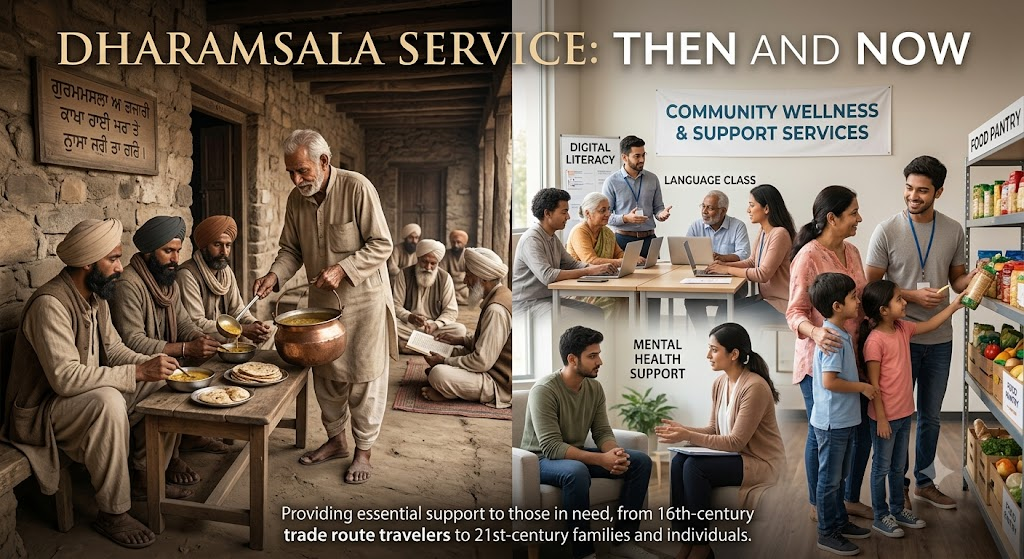
The needs of the 16th and 21st centuries are different in form but not in kind. The early dharamsala fed travelers on trade routes who had nowhere else to stop. Today’s equivalent is the family navigating a food pantry for the first time after a job loss, the elderly immigrant who does not speak enough English to understand a medical diagnosis, the young person with no one to turn to for guidance on education or career or mental health. The early dharamsala offered a hospital ward for the sick and injured. Today that looks like free health clinics, mental health support, and legal aid for those who cannot afford it. The early dharamsala taught literacy in Gurmukhi, so ordinary people could access their own scripture. Today that looks like after-school tutoring, language classes, and digital literacy for seniors.
None of this requires abandoning the sanctity of the Darbar Sahib or diluting what the Gurdwara means spiritually. It requires recognizing that the building you walk into every Sunday was designed by Guru Nanak to be the most useful institution in its surrounding community — not the most exclusive one. The Nishan Sahib that flies above the Gurdwara is visible to everyone in the neighborhood. It was always meant to signal to everyone in that neighborhood: there is help here, there is food here, there is dignity here, regardless of who you are.
The mahants of the 18th century narrowed the Gurdwara into a private ritual space and extracted its resources for personal benefit. The Sikh community fought for a century to take it back. It would be a quiet irony if today’s leaders, with the best of intentions, completed that narrowing themselves — not through greed, but through an overly cautious reading of what a sacred institution is permitted to do.
Guru Nanak’s standard was simple and demanding in equal measure: the door is open to everyone, no one leaves hungry, service is the most direct form of devotion, and the welfare of the whole community — not just its Sikh members — is a sacred responsibility. Five hundred years later, that remains the design. The only question is whether those entrusted with these institutions have the vision and the will to honor it fully.