
What a Sparrow Knows That We Have Forgotten
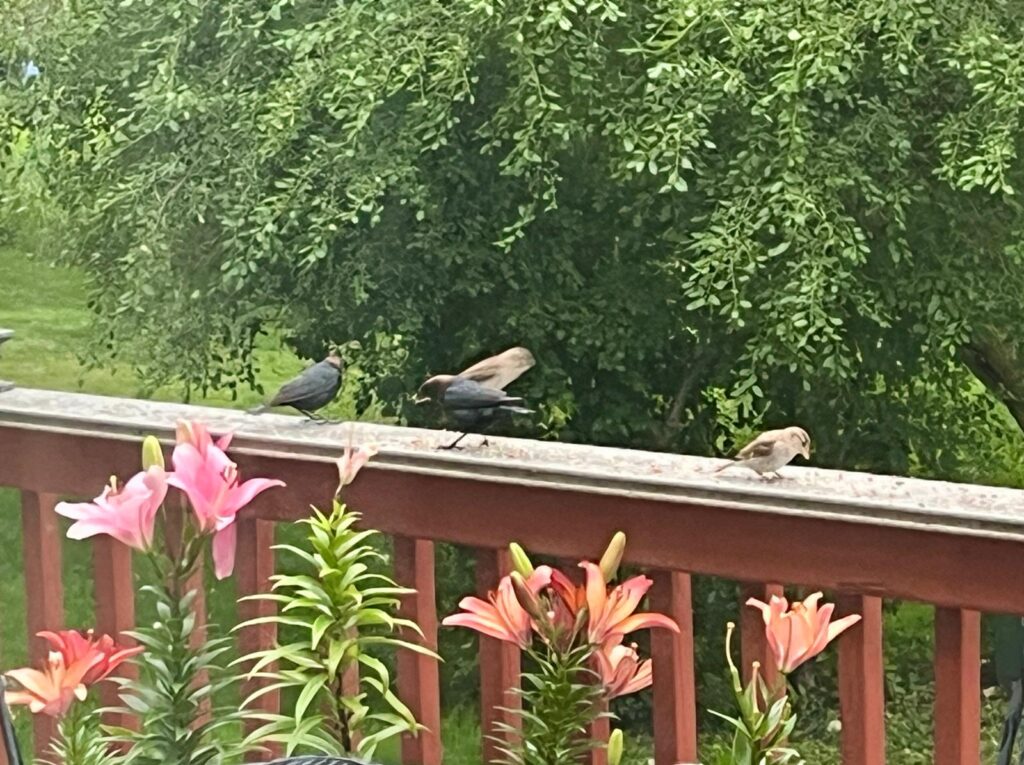
This morning at a bird feeder, I observed something that made me think.
A fledgling sparrow — old enough to pick up grain by herself, and doing so — suddenly flickered her wings in a particular way. Her mother, who had been watching, immediately picked up a seed and placed it in the young one’s mouth.
The chick could feed herself. She knew it. The mother knew it. And yet the ancient signal was sent, and the ancient response followed.
What was witnessed in that small moment was one of nature’s most honest stories — a story about love, duty, capability, dependence, and the delicate negotiation between holding on and letting go. A story the sparrow lives instinctively. A story the human spends an entire lifetime trying to learn.
The Sparrow’s Way
A sparrow’s parenting journey is precise, compressed, and complete.
The eggs hatch after twelve to fourteen days. The chicks arrive naked, blind, and entirely helpless — unable to regulate their own temperature or feed themselves. Both parents begin a feeding schedule of extraordinary intensity — every fifteen to twenty minutes from dawn to dusk, delivering soft insects to open mouths that can do nothing but receive.
By the second week, feathers begin to emerge. Eyes open. The chick begins to recognize her parents’ specific calls. Something like a relationship — beyond pure biology — starts to form.
Then something elegant happens in the third week. The mother, sensing the next brood’s need, begins preparing for the next clutch. The father takes over primary feeding. Two parallel purposes — reproduction and parental care — run simultaneously. Nature wastes nothing.
By day twenty-one, the fledgling leaves the nest. But parental care does not stop. For another ten to fourteen days, the parents continue feeding and guarding — while gradually, deliberately, withdrawing. The parent begins delaying its chicks’ response to begging. Then ignoring it. Then the feeding stops entirely. The young sparrow joins a juvenile flock. The parents do not grieve. The young sparrow does not look back.
The entire arc — from hatching to independence — takes approximately forty-five days.
And then it is simply done.
The Wing Flutter — A Negotiation
The wing flutter witnessed at the feeder tells a subtler story within the larger one.
The chick flickering her wings is sending a hardwired biological signal: I am your offspring. I am hungry. Feed me. The mother, despite knowing the chick can feed herself — having just watched her do it — responds anyway. The signal is still too strong to ignore.
This small moment is what behavioral scientists call parent-offspring conflict — one of nature’s oldest negotiations.
The chick’s interest is clear: extend parental feeding as long as the signal works. The wing flutter costs almost nothing. Being fed by the mother is guaranteed and effortless. Why forage independently when the ancient signal still functions?
The mother’s interest is equally clear: this chick is capable. The next brood is waiting. The withdrawal must begin.
The compromise witnessed is the negotiation itself — the chick oscillating between independence and dependence, the mother responding less reliably than before but not yet fully withdrawn. In a few days the mother will begin ignoring the flutter entirely. The chick will have no choice. The signal will stop being sent. Independence will arrive — not as a choice but as an inevitability shaped by the gradual withdrawal of what made dependence possible.
The sparrow does not agonize over this transition. It simply lives it.
What Limits the Human
The sparrow releases because biology turns off the signal. The feeding response stops. The attachment circuit closes. Clean and automatic.
The human has no such biological off-switch.
Every shared memory, every sacrifice made, every identity constructed around the role of parent — all of it accumulates into a weight the sparrow never carries. The parent who spent twenty years defining themselves as mother or father does not simply stop being that when the child leaves for college. The role was the identity. The empty house is not just quiet — it is an identity wearing the clothing of a logistical change.
Emotion deepens what the sparrow simply completes. This is both the gift and the cost of human consciousness.
The children grow. High school becomes college. College becomes a job somewhere. The job takes them to a city that is not yours. This is exactly as it should be. The healthy arc of human development mirrors the sparrow’s — from total dependence, through gradual capability, to complete independence.
The difficulty is not in understanding this intellectually. It is in living it without the biological off-switch that makes it effortless for the sparrow.
The Empty Nest — An Identity Crisis in Disguise
The challenge of the empty nest is rarely about time. There is suddenly more time, yes. But the real question beneath the practical one is deeper:
If I am no longer primarily needed by them — what am I for? This is the genuine question. Time is merely its symptom. Different people answer it differently.
Some turn outward — redirecting the parenting energy toward community, seva, mentoring. The care that once went to children flows toward those who still need it. This is the most psychologically complete answer available — not because it replaces what was lost, but because it locates purpose in something that does not depend on any particular person remaining in any particular stage of life.
Some turn inward — toward the self that was deferred during the parenting years. Finding a hobby. Reading, pursuing creativity, deepening spiritual practice. This too is a valid answer — building an identity that belongs to oneself alone, that does not require anyone else’s need to remain meaningful.
Some cannot let go — hovering over adult children, filling the void with control rather than release. This path damages both the parent and the child. The chick who is not allowed to forage independently never develops the strength she needs. The parent who prevents the separation prevents their own as well.
The Grandchildren — A Second Attachment, A Second Release
Here the story becomes more poignant.
Grandchildren often serve a function that is rarely acknowledged honestly. They restore the identity that was lost when the children left. The role of grandparent fills the space where parent once lived. The biological meaning returns. The relationship deepens. The attachment, once again, becomes central.
But the mathematics are identical to the first time — just compressed into fewer remaining years, with less energy for compensation and a more acute awareness of time.
The grandchildren grow. They need the grandparents less. The second release arrives. And it arrives when the grandparent is older, less mobile, less able to redirect the energy outward, and more aware of what endings mean.
The cruelty of the second release is its timing. The first release — children leaving — happens when parents are typically forty-five to fifty-five, still vital, still professionally engaged, with decades ahead. The second release often arrives at seventy to eighty — when compensating activities are fewer, mortality is closer, and the awareness of diminishing time is acute.
The sparrow never faces a second cycle. For the human, the second release is often harder than the first.
What Gurbani Says to All of This
Gurbani does not avoid this human reality. It speaks to it directly — and with more precision than any modern psychology.
The lotus is Gurbani’s most repeated metaphor for a reason.
ਜਲ ਮਹਿ ਉਤਪਲੁ ਰਹੈ ਜਿਉ ਜਲ ਮਹਿ ਰਹੈ ਕਮਲੁ ॥ As the lotus remains in the water yet above it.
The lotus does not leave the water. It is not indifferent to the water. It draws its nourishment from the water. And yet it is not submerged by it. The water does not define the lotus. The lotus simply is — regardless of water level, regardless of season, regardless of who is watching it bloom.
This is the answer to the empty nest. To the grandchildren who have grown. To every stage of life that arrives and then passes.
Your existence does not require an audience to be complete.
ਮੋਹੁ — attachment — is named in Gurbani as one of the five forces that bind the human consciousness to suffering. Not love itself. Not relationship itself. But the possessive clinging to what we love — the insistence that what we love must remain what it was — that creates suffering when life moves, as it always does, in only one direction.
The sparrow has no Moh. It loves completely in each stage. Feeds with total commitment. And releases completely when the time comes. No clinging. No grief. No asking why the fledgling had to leave.
Guru Nanak Ji described the highest human state as having this same quality — loving fully without possessing. Serving completely without the ego’s need to be needed.
ਨਾਨਕ ਸਤਿਗੁਰਿ ਭੇਟਿਐ ਪੂਰੀ ਹੋਵੈ ਜੁਗਤਿ ॥ O Nanak — meeting the true Guru, the way of living becomes complete.
The way of living that is complete is not a life without love or relationship. It is a life in which love does not require the beloved to remain what they were. In which service does not require the served to remain in need. In which identity does not collapse when the role changes.
This is what the sparrow does instinctively in forty-five days.
This is what the human is invited — through Gurbani, through life’s accumulated teachings, through the honest observation of a fledgling at a bird feeder — to learn to do consciously across an entire lifetime.
The Wing Flutter, Revisited
The mother at the feeder placed food in the chick’s mouth one more time.
She knew the chick could feed herself. The chick knew it too. But the signal was sent — the ancient flutter of wings — and the ancient response followed one more time.
In a few days the flutter will stop being sent. The mother will not notice its absence. The chick will not mourn the loss of what she flickered her wings for. They will simply have moved — each of them — into the next stage of what their lives require.
No drama. No grief. Just Hukam moving through two small birds on a summer morning.
The human watching them — perhaps understanding something about love and release that took a lifetime to see clearly — carries both the gift and the weight that the sparrow never will.
The capacity to grieve the leaving.
And the invitation, held open by every Guru’s teaching, every lotus on every still water, every fledgling who learns to forage on her own:
To love what is here fully. To release what must go gently. To find — in the space between — not emptiness, but the quiet completeness of a life lived within Hukam.